

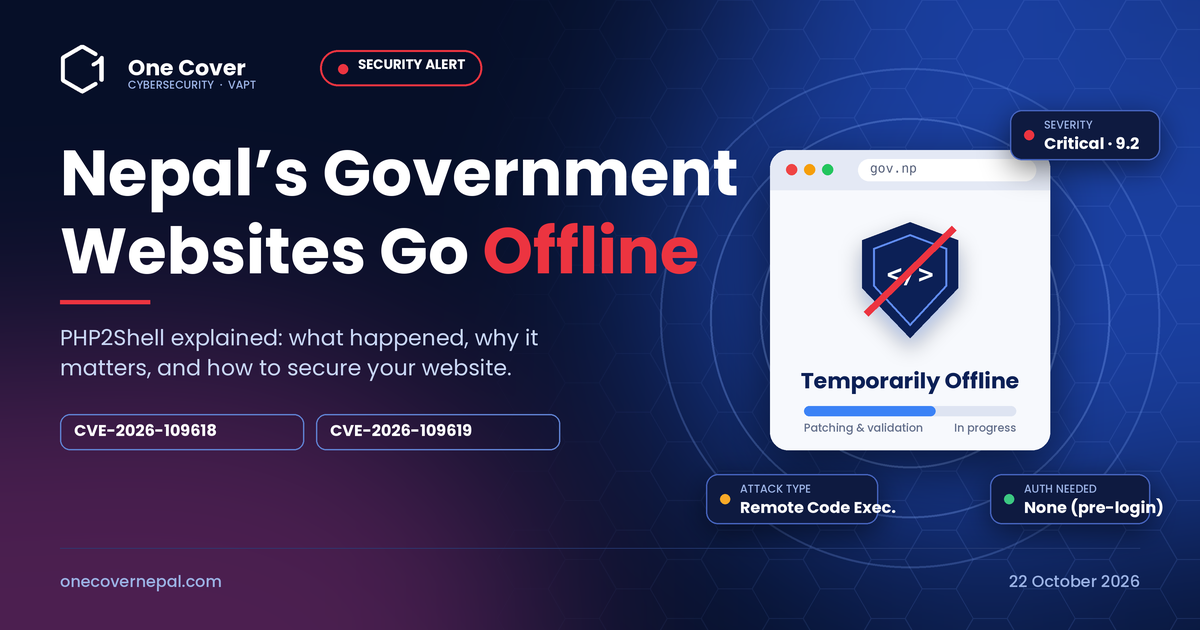

The Software Development and Operation Center (SDOC) issued an urgent security notice stating that multiple government websites and digital services were temporarily suspended to prevent potential cyberattacks[cite: 4]. The action follows the public disclosure of two critical flaws in PHP, the scripting language powering a massive portion of web servers globally[cite: 4].
| Identifier | Vulnerability Type | Severity |
|---|---|---|
| CVE-2026-109618 | Remote Code Execution (out-of-memory corruption) | Critical (CVSS 9.2) |
| CVE-2026-109619 | Remote Code Execution (stale global state) | Critical (CVSS 9.2) |
Remote Code Execution (RCE) enables an attacker to run arbitrary system commands directly on the host server[cite: 4]. SDOC highlighted that exploitation requires no user authentication, making unpatched systems immediate targets[cite: 4]. SDOC also refers to the threat as “PHP@Shell” in official communications[cite: 4].
This risk extends far beyond Nepal. The PHP project released emergency security updates, prompting government agencies, cloud providers, and organizations worldwide to temporarily suspend vulnerable web applications while executing patch cycles[cite: 4].
Any system running PHP—including WordPress, Laravel, CodeIgniter, Joomla, Drupal, or custom platforms—is potentially vulnerable[cite: 4].
| Priority | Action Step |
|---|---|
| Immediate | Check your active PHP runtime version (via php -v or your server control panel)[cite: 4]. |
| Immediate | Execute a complete backup of server files and databases, storing copies off-server[cite: 4]. |
| Immediate | Apply the latest security update released for your specific PHP branch[cite: 4]. |
| High | Update CMS cores, plugins, dependencies, and web application frameworks[cite: 4]. |
| High | Review server access logs for anomalous requests, unexpected script executions, or new admin accounts[cite: 4]. |
One Cover Pvt. Ltd. is Kathmandu’s dedicated cybersecurity and VAPT provider[cite: 4]. Our team helps organizations perform rapid vulnerability scans, verify PHP patch integrity, and conduct complete security audits[cite: 4].