

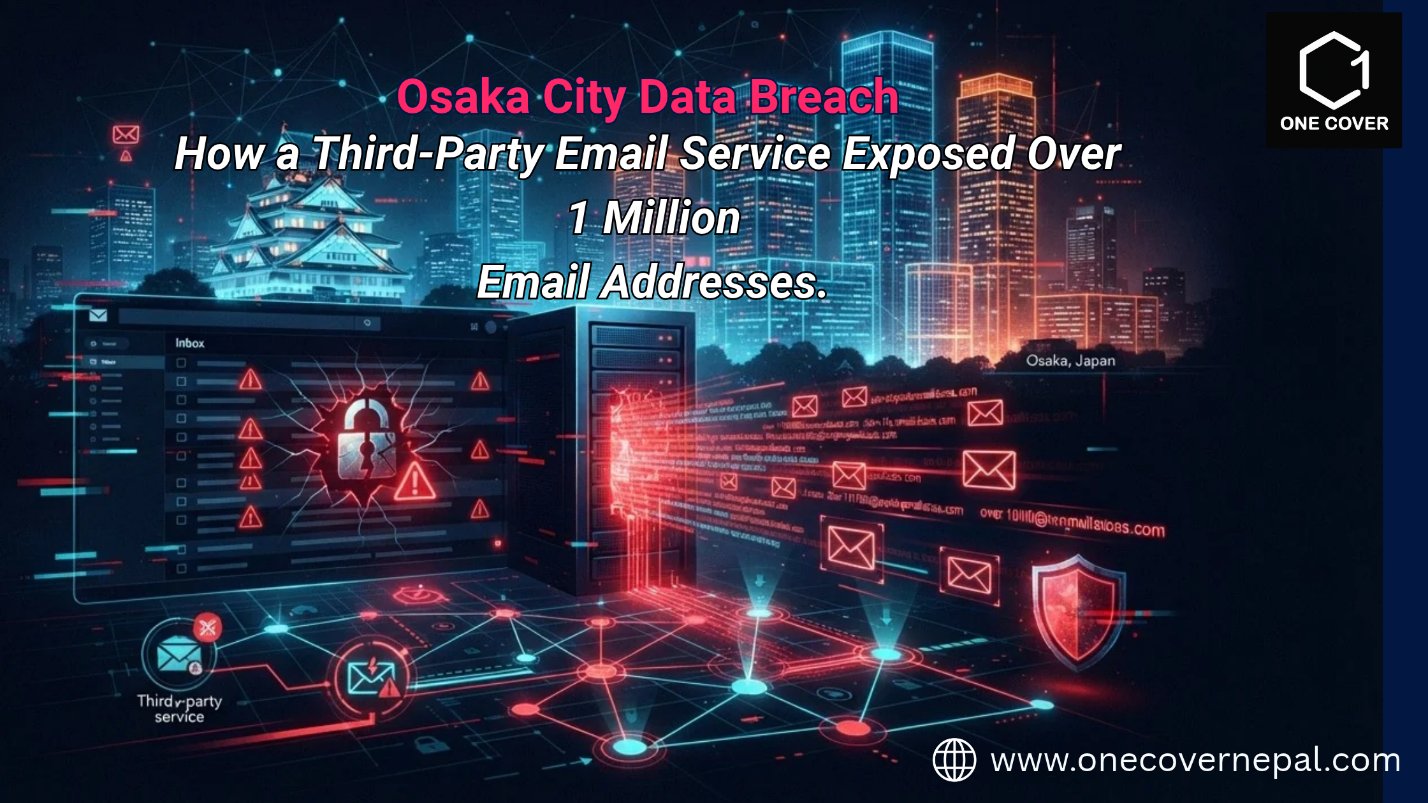
On 13 November 2026, Osaka City announced that 1,078,713 email addresses connected to its online administrative services had been exposed after a cyberattack on an external email-distribution service. The attack did not directly breach Osaka City's own systems. Instead, criminals targeted Arara Message, an email service used by TKC Corporation, the company that operates the city's online administrative platform.
This incident is a strong reminder that cybersecurity is not only about protecting an organization's own network. It is also about protecting the suppliers, vendors, and service providers that handle sensitive information on its behalf.
Osaka City uses an online system where residents can create accounts, log in, submit applications, and receive official notifications. TKC Corporation operates this system and sends notification emails through Arara Message.
In early November, Arara reported that attackers had gained unauthorized access to its email-distribution infrastructure. Because of this breach, email addresses that Osaka City's online administrative system had used between 1 July and 31 October 2026 were exposed.
The exposed information was mainly email addresses. Osaka City stated that email bodies, My Number data, and application details were not leaked. However, email addresses are still valuable to criminals because they can be used to send convincing phishing emails that appear to come from the city.
The attackers targeted Arara Message, the external email service used by TKC Corporation to send notification emails for Osaka City's online administrative system. They gained unauthorized access to Arara's email infrastructure by exploiting vulnerabilities in its web systems.
After accessing the system, the attackers viewed email recipient lists connected to Osaka City's online services. This exposed 1,078,713 email addresses used between 1 July and 31 October 2026.
The attackers then used compromised mail servers to send phishing emails impersonating banks and credit card companies. These emails tried to trick people into clicking malicious links and entering passwords, PINs, or credit card details.
Many people believe that an email address alone is not sensitive information. However, attackers can use exposed email addresses to carry out phishing attacks.
In this case, criminals could send messages pretending to be from Osaka City, a bank, or a credit card company. If a person believes the message is real, they may click a malicious link and enter their password, PIN, or credit card details on a fake website.
The problem was not limited to Osaka City. Arara's breach affected email addresses connected to many other customers, with tens of millions of addresses exposed overall. This shows how one security failure at a service provider can affect many organizations and individuals at the same time.
This incident is an example of a supply chain cyberattack. Instead of attacking Osaka City directly, the attackers targeted a service provider in its digital supply chain.
Osaka City depended on TKC Corporation, and TKC depended on Arara Message to deliver emails. When Arara was compromised, the impact reached Osaka City and its residents.
The attack chain can be understood like this:
Attacker → Arara Message → TKC Corporation → Osaka City's online services → Residents
This is why supply chain attacks are dangerous. Even if an organization has strong security, a weakness in one of its vendors can still expose user data and create serious risks.
Osaka City warned residents to be careful with unexpected emails claiming to come from the city or its online administrative system. The city advised people not to open suspicious links or attachments and not to enter passwords, PINs, credit card details, or payment information through links in emails.
Residents were also told to verify official information directly through Osaka City's official website rather than trusting links in unexpected emails.
Arara also filed a damage report with Osaka Prefectural Police, and an investigation into the breach was ongoing. The incident shows the importance of quick communication after a cyberattack, especially when residents may receive phishing messages pretending to be from a trusted organization.
The Osaka City breach teaches an important lesson: organizations must assess the security of their vendors, not only their own systems.
Organizations should require strong security controls from suppliers, limit the amount of data shared with third parties, monitor unusual email activity, patch vulnerabilities quickly, and prepare an incident response plan. They should also have a clear process for warning users quickly when a supplier is compromised.
For individuals, the lesson is equally important. Never trust an email just because it looks official. Do not click unexpected links, do not download unknown attachments, and never enter personal or financial information through a link sent by email. If a message claims to be from a bank, government office, or company, visit the official website directly by typing its address into your browser.
The Osaka City breach proves that cyberattacks do not always begin with the organization that suffers the consequences. A weakness in one supplier can expose the data of thousands or even millions of people.
In today's connected digital world, strong cybersecurity must extend beyond an organization's own systems to every partner, vendor, and service it trusts. The Osaka incident is a warning for governments, companies, and individuals: one compromised third-party service can turn into a major data security crisis.